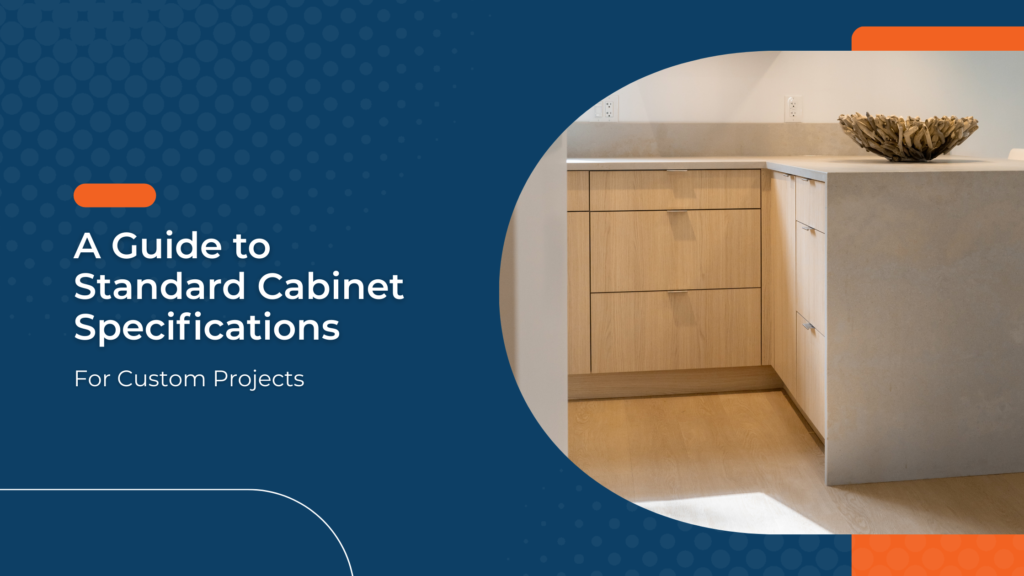
Cabinet manufacturers use standard cabinet specifications to create a consistent baseline, even in custom work. These specifications define how cabinets are constructed, sized, and engineered before any project-specific changes are applied. While each manufacturer constructs its cabinets differently, these standards are a great resource for designers because they break down basic cabinet construction and what to expect.
Standard Specifications for Cabinet Sides
Base cabinets are usually 34.5″ high and 24″ deep. Widths are usually available in 3″ increments. Cabinets will include drawers, pullouts, doors, or a combination of them.
Wall cabinets are typically 12″ deep. Widths are usually available in 3″ increments, and heights in 6″ increments. They most often feature doors, and in some cases, might include a drawer, particularly when positioned above a countertop.
Tall cabinets are generally 24″ deep and can reach heights up to 96″. Widths are offered in 3″ increments. They may include a combination of doors, drawers, pullouts, or interior storage accessories.
Cabinet box sides are often a melamine-covered particleboard. This makes up the body of the cabinet, which is often called a carcass or case. They are usually available in 2 case colors:
- white melamine (default)
- natural maple melamine
Typical sides will have melamine on the inside and outside. The cabinet box front facing edge has a PVC edge banding to match the door or case color as close as possible.
Standard Cabinet Specifications for Top and Bottom Floors
In custom cabinetry, it is common to have a partial top floor. Our cabinet standard is a full 5/8″ melamine-covered particleboard top and bottom floor.
Standard Specifications for Cabinet Backs
A cabinet back is the panel on the wall-facing side of a cabinet box that encloses the structure, adding strength. All Decor cabinets have a melamine-covered hardboard cabinet back.
Standard Cabinet Specifications for Adjustable Shelves
All adjustable shelves are made of melamine-covered particleboard.
Standard Specifications for Finished Adjustable Shelves
All adjustable shelves in a cabinet with a finished interior are veneer-covered particleboard, finished on both sides to match the door.
Standard Cabinet Specifications for Fixed Shelves
All fixed shelves are made of melamine-covered particle board.
Standard Cabinet Specifications for Hanger Rails
Hanger rails are horizontal support rails installed inside or along the back of a cabinet box. Hanger rails are typically 3-4″ wide and provide a solid surface for wall mounting.
Standard Drawer Box Specifications
Drawer boxes will be constructed from melamine-covered particleboard and are typically dadoed together. Custom cabinets can be upgraded to premium dovetail maple drawer boxes.
Standard Specifications to Pull-out Shelves
Pull-out shelves are typically made from a white melamine-covered particleboard bottom floor. Standard pull-out shelves are 4-1/4″ high, but can be customized to varying heights.
Standard Cabinet Specifications for Drawers and Pull-out Tracks
There are many different types of drawers and pull-out tracks. Our standard is an undermount track with Blumotion, which is a soft-close mechanism.
Standard Specifications for Cabinet Doors
Doors are generally mortise and tenon or mitered. Cabinet doors can be made from different wood species as well as MDF or HDF.
Standard Specifications for Cabinet Hinges
Our standard is a soft-close hinge on most cabinets. Soft-close hinges are common across custom cabinet brands.
Customizing Cabinets Beyond Standard Sizing
Standard cabinet specifications define what you can expect in every cabinet. They establish consistent construction methods and important functional limits, which ensures each cabinet performs as intended within proven size and engineering parameters.
For our custom cabinets, each cabinet can be built within defined minimum and maximum dimensions, allowing you to adapt designs to your client’s home while staying within structural guidelines. When a project requires adjustments beyond those standards, it becomes a custom modification, and our team will create a CAD drawing with you to confirm accuracy and feasibility. Within these boundaries, you still have plenty of design options from materials to finishes.